WITH “725,000 SF OF DIGITAL MUSCLE” – WHY THE ST. LOUIS GLOBE BUILDING IS THE ULTIMATE URBAN CARRIER HOTEL
In the heart of St. Louis, a city historically defined by its role as the “Gateway to the West,” a new kind of frontier is being settled. It isn’t measured in miles of railroad track or river tonnage, but in petabytes, milliseconds, and megawatts.
Standing as a monument of this digital age is The Globe Building, a 725,000-square-foot Art Deco fortress that has been meticulously reimagined for the 21st century.
Known colloquially as the “High-Tech Castle,” The Globe Building is far more than a historic landmark renovation. It has evolved into a unique, urban carrier-class data center hotel, specifically engineered for the high-intensity demands of Artificial Intelligence (AI) mission workloads.
With a rare synergy of massive physical infrastructure, uncollocated power reserves, and a nationally-significant secure intelligence footprint — The Globe is repositioning St. Louis as a primary hub for the Global Geospatial Intelligence (GEOINT) and AI sectors.
The Globe Building in St. Louis
To understand why The Globe Building is being dubbed a “High-Tech Castle,” one must look at the anatomy and the three foundational pillars that define its utility: Big Space, Big Power, and Big Fiber.
In the world of data centers, these are the “holy trinity of infrastructure,” and The Globe offers them at a scale that few urban facilities in North America can match.
1. BIG SPACE
The building’s origins as a 1930s railroad terminal give it an architectural over-engineering that modern developers would deem excessive. The floor loads are massive, easily capable of supporting the heavy racks of UPS systems and other high-density infrastructure required for AI models.
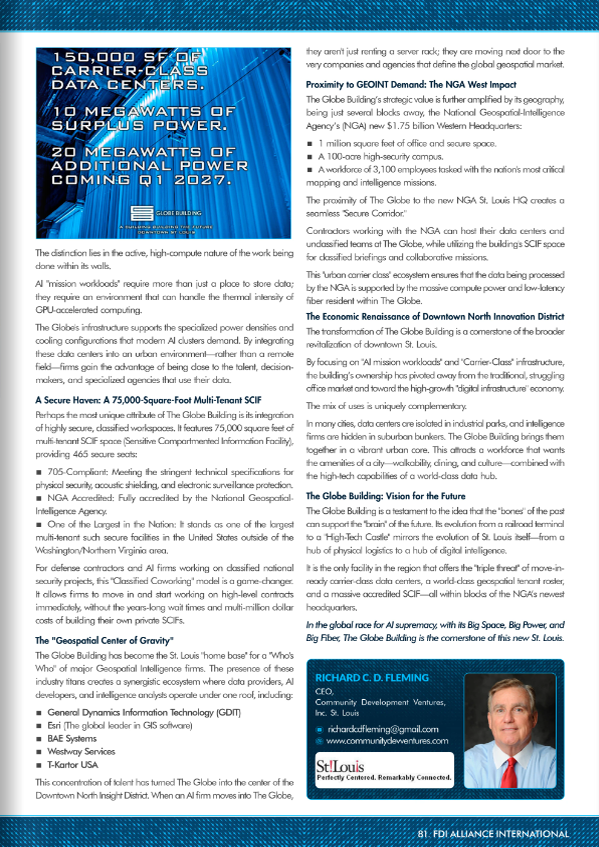
Within its 725,000 square feet, the building currently houses 150,000 square feet of carrier-class data centers. For AI firms, this isn’t just about floor space; it’s about the “mission-ready” capacity of the building to scale horizontally and vertically.
2. BIG POWER FUELING THE AI ENGINE
If “space is the body,” then power is the blood. AI workloads — those involving Large Language Models (LLMs) and neural networks — require substantial, predictable power. While many urban centers are currently “power constrained,” The Globe Building is in an enviable position of surplus.
The building has recently added 10 MW of uncollocated utility power, specifically set aside for new tenants and expansions. Looking ahead, an additional 20 MW of power online in 2027.
This roadmap provides a rare level of certainty for firms that need to know their “High-Tech Castle” won’t run out of fuel as their AI mission workloads grow.
3. BIG FIBER – THE CARRIER-NEUTRAL HOTEL
As an Urban Carrier Hotel, The Globe Building serves as a critical internet hub for the Midwest. It features a robust Meet-Me-Room (MMR) where more than 12 major fiber providers terminate. This carrier neutrality allows tenants to cross-connect with minimal latency.
The Globe combines a 705-compliant, 465-seat, multi-tenant SCIF with 150,000 SF of adjacent carrier-class data centers within the same facility. Classified ops, unclassified collaboration, and in-building compute under one roof in downtown St. Louis.
Perhaps the most unique attribute of The Globe Building is its integration of highly secure, classified workspaces. It features 75,000 square feet of multi-tenant SCIF space (Sensitive Compartmented Information Facility), providing 465 secure seats:
705-Compliant: Meeting the stringent technical specifications for physical security, acoustic shielding, and electronic surveillance protection.
NGA Accredited: Fully accredited by the National Geospatial-Intelligence Agency.
One of the Largest in the Nation: It stands as one of the largest multi-tenant secure facilities in the United States outside of the Washington/Northern Virginia area.
For defense contractors and AI firms working on classified national security projects, this “Classified Coworking” model is a game-changer. It allows firms to move in and start working on high-level contracts immediately, without the years-long wait times and multi-million-dollar costs of building their own private SCIFs.
The Geospatial Center of Gravity
The Globe Building has become the St. Louis “home base” for a “Who’s Who” of major Geospatial Intelligence firms. The presence of these industry giants creates a synergistic ecosystem where data providers, AI developers, and intelligence analysts operate under one roof, including:
General Dynamics Information Technology (GDIT)
Esri (The global leader in GIS software)
BAE Systems
Westway Services
T-Kartor USA
This concentration of talent has turned The Globe into the center of the Downtown North Innovation District. When an AI firm moves into The Globe, they aren’t just renting a server rack; they are moving next door to the very companies and agencies that define the global geospatial market.
Proximity to GEOINT Demand: The NGA West Impact
The Globe Building’s strategic value is further amplified by its geography, being several blocks away from the National Geospatial-Intelligence Agency’s (NGA) new $1.75 billion Western Headquarters:
1 million square feet of office and secure space.
A 100-acre high-security campus.
A workforce of 3,100 employees tasked with the nation’s most critical mapping and intelligence missions.
The proximity of The Globe to the new NGA St. Louis HQ creates a seamless “Secure Corridor.” Contractors working with the NGA can house their data centers and classified teams at The Globe, while utilizing its SCIF space for classified briefings and collaborative missions.
This “urban carrier-class” ecosystem ensures that the data being processed by the NGA is supported by the massive compute power and low-latency fiber resident within The Globe.
The Economic Renaissance of Downtown North Innovation District
The transformation of The Globe Building is a cornerstone of the broader revitalization of downtown St. Louis.
By focusing on AI mission workloads and “Carrier-Class” infrastructure, the building’s ownership has pivoted away from the traditional, struggling office model and toward the high-growth digital infrastructure economy.
The mix of uses is uniquely complementary.