PLAYBOOK WHICH CREATED THE "WORLD CLASS BIO BELT" NOW SETS THE STAGE FOR ST. LOUIS' GLOBAL GEOSPATIAL INTELLIGENCE HUB
This year marks the 25th year in the evolution of St. Louis into today's world-renowned Plant and Life Science hub—referred to historically as the "BioBelt."
Since 2000, the St. Louis Plant & Life Sciences BioBelt has become one of the most successful examples of innovation-based regional economic transformation in the United States.
Driven by public-private collaboration, regional institutional anchors, and strategic capital investment, St. Louis transitioned from a traditional manufacturing center into a top-tier global center for bioscience and agricultural technology.
Over two decades ago, the initiative commenced with the Danforth Foundation and the St. Louis Regional Chamber & Growth Association (RCGA) jointly funding a biotech industry cluster strategy by the Battelle Memorial Institute.
As part of the strategy, business and civic leaders branded St. Louis the "BioBelt" to market its unique combination of agricultural geography, plant genomics expertise, and clinical medical research.
St. Louis' Plant and Life Sciences rise moved forward with longstanding heavyweights in agriculture and medicine, including Monsanto (now Bayer Crop Science), Bunge, Washington University in St. Louis, Saint Louis University, and BJC HealthCare --- adding to these, the creation of the Donald Danforth Plant Science Center which has become the preeminent plant science research institution in the world.
Regional leaders spent the next two-plus decades building a robust Plant & Life Sciences Ecosystem by creating a dedicated civic organization, BioSTL (initially the Coalition for Plant & Life Sciences), to implement the Battelle Strategy. BioSTL's venture arm, BioGenerator, was recently featured by TIME Magazine as the #2 Health & Life Sciences Incubator/Accelerator in the U.S.
BioSTL just celebrated its 25th anniversary. biostl.org
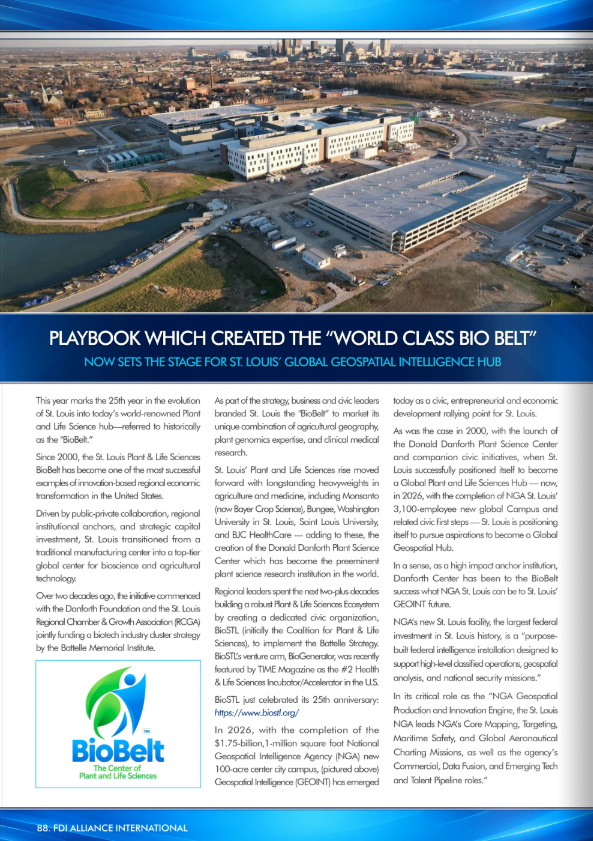
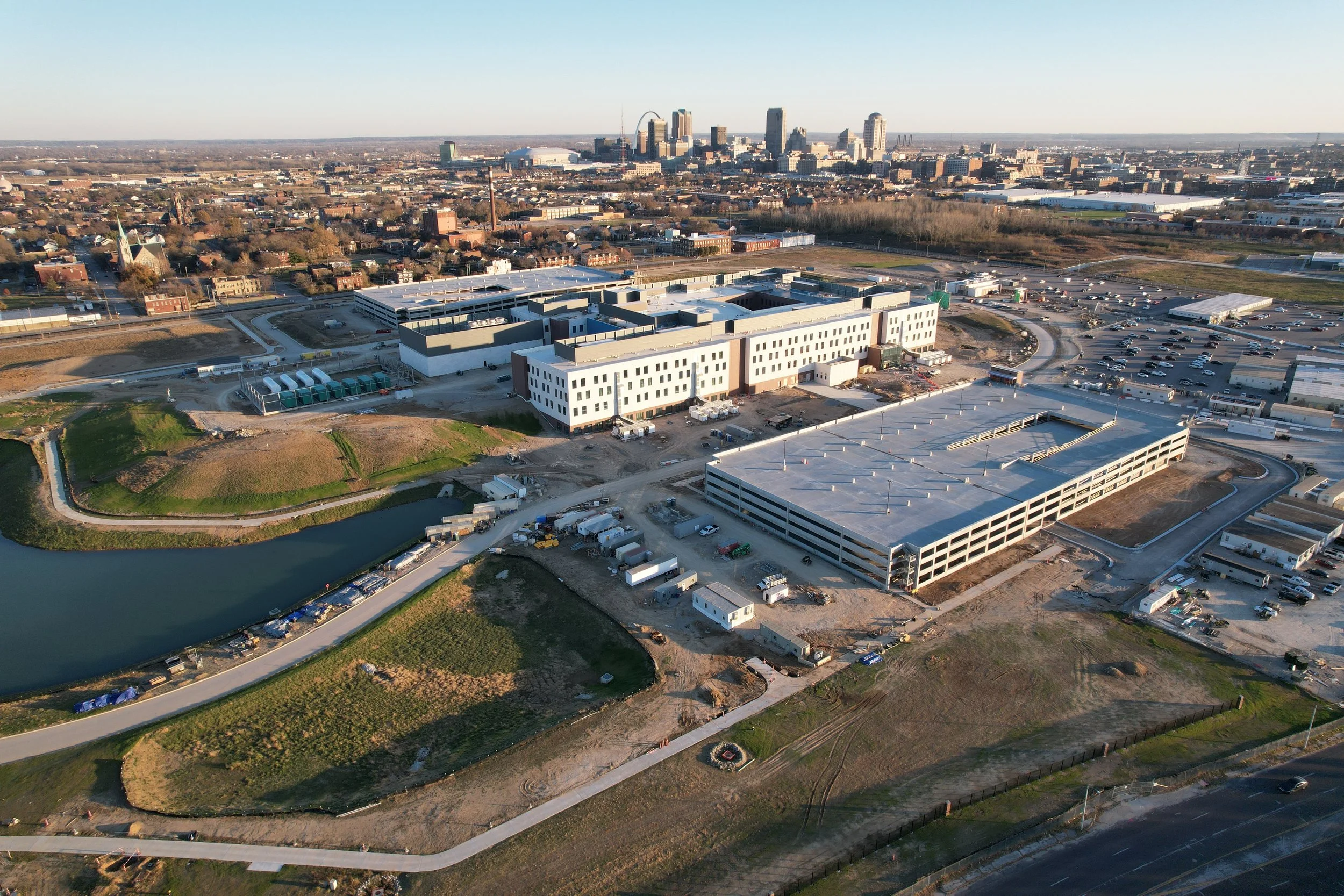
In 2026, with the completion of the $1.75-billion, 1-million square foot National Geospatial Intelligence Agency (NGA) new 100-acre center city campus, Geospatial Intelligence (GEOINT) has emerged today as a civic, entrepreneurial and economic development rallying point for St. Louis.
As was the case in 2000, with the launch of the Donald Danforth Plant Science Center and companion civic initiatives, when St. Louis successfully positioned itself to become a Global Plant and Life Sciences Hub — now, in 2026, with the completion of NGA St. Louis' 3,100-employee new global Campus and related civic first steps — St. Louis is positioning itself to pursue aspirations to become a Global Geospatial Hub.
In a sense, as a high impact anchor institution, Danforth Center has been to the BioBelt success what NGA St. Louis can be to St. Louis' GEOINT future.
NGA's new St. Louis facility, the largest federal investment in St. Louis history, is a "purpose-built federal intelligence installation designed to support high-level classified operations, geospatial analysis, and national security missions."
In its critical role as the "NGA Geospatial Production and Innovation Engine, the St. Louis NGA leads NGA's Core Mapping, Targeting, Maritime Safety, and Global Aeronautical Charting Missions, as well as the agency's Commercial, Data Fusion, and Emerging Tech and Talent Pipeline roles."
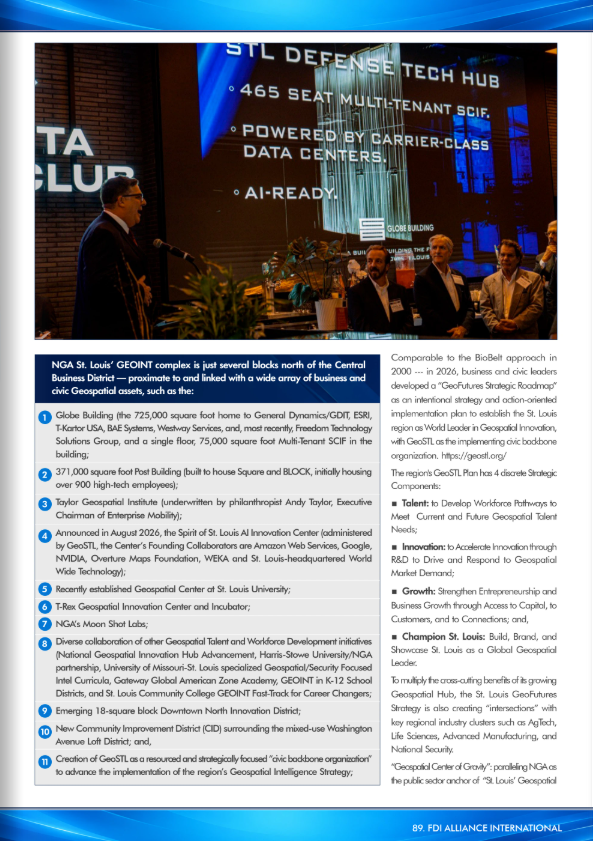
NGA St. Louis' GEOINT complex is just several blocks north of the Central Business District — proximate to and linked with a wide array of business and civic Geospatial assets, such as the:
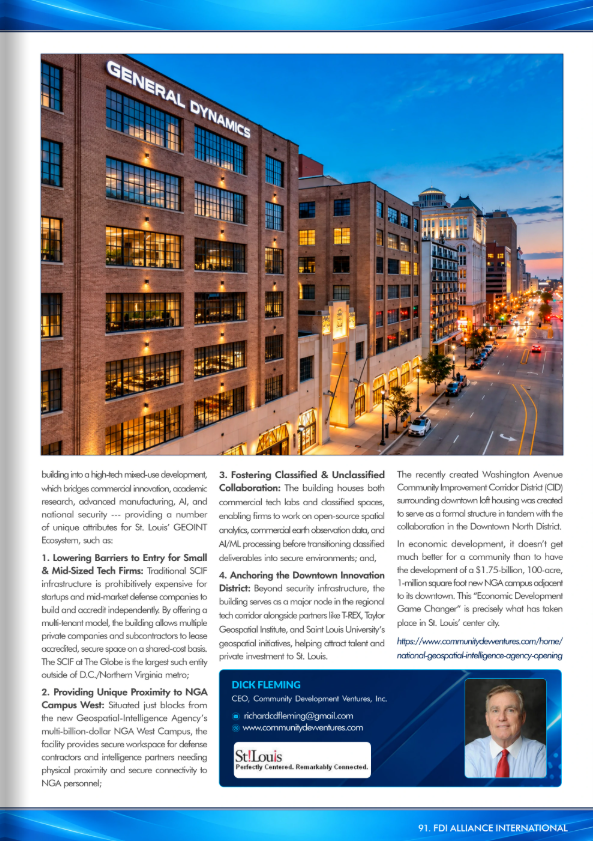
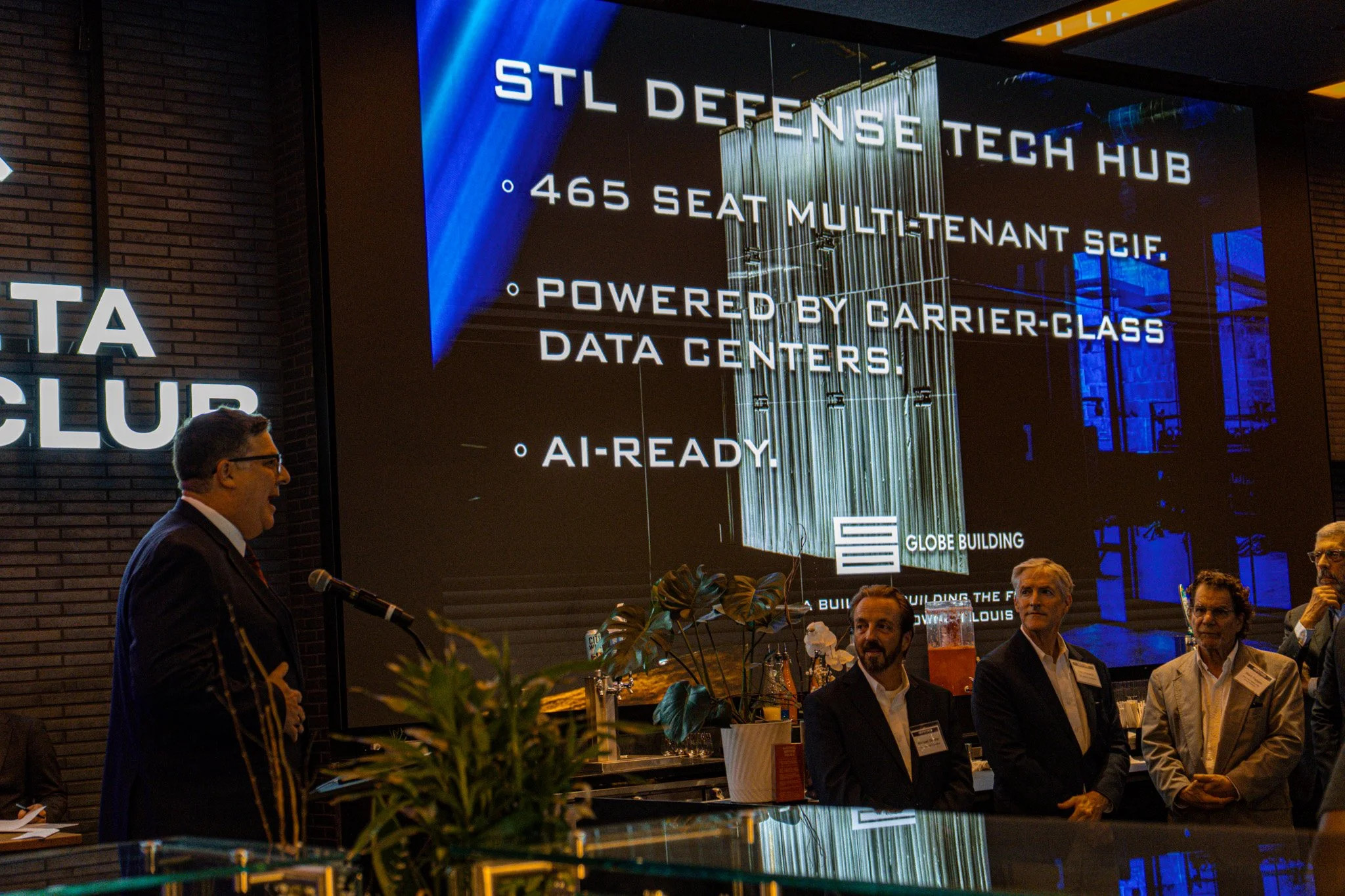
Globe Building (the 725,000 square foot home to General Dynamics/GDIT, ESRI, T-Kartor USA, BAE Systems, Westway Services, and, most recently, Freedom Technology Solutions Group, and a single floor, 75,000 square foot Multi-Tenant SCIF in the building;
371,000 square foot Post Building (built to house Square and BLOCK, initially housing over 900 high-tech employees);
Taylor Geospatial Institute (underwritten by philanthropist Andy Taylor, Executive Chairman of Enterprise Mobility);
Announced in August 2026, the Spirit of St. Louis AI Innovation Center (administered by GeoSTL, the Center's Founding Collaborators are Amazon Web Services, Google, NVIDIA, Overture Maps Foundation, WEKA and St. Louis-headquartered World Wide Technology);
Recently established Geospatial Center at St. Louis University;
T-Rex Geospatial Innovation Center and Incubator;
NGA's Moon Shot Labs;
Diverse collaboration of other Geospatial Talent and Workforce Development initiatives (National Geospatial Innovation Hub Advancement, Harris-Stowe University/NGA partnership, University of Missouri-St. Louis specialized Geospatial/Security Focused Intel Curricula, Gateway Global American Zone Academy, GEOINT in K-12 School Districts, and St. Louis Community College GEOINT Fast-Track for Career Changers;
Emerging 18-square block Downtown North Innovation District;
New Community Improvement District (CID) surrounding the mixed-use Washington Avenue Loft District; and,
Creation of GeoSTL as a resourced and strategically focused "civic backbone organization" to advance the implementation of the region's Geospatial Intelligence Strategy;
Comparable to the BioBelt approach in 2000 --- in 2026, business and civic leaders developed a "GeoFutures Strategic Roadmap" as an intentional strategy and action-oriented implementation plan to establish the St. Louis region as World Leader in Geospatial Innovation, with GeoSTL as the implementing civic backbone organization. geostl.org
The region's GeoSTL Plan has 4 discrete Strategic Components:
Talent: to Develop Workforce Pathways to Meet Current and Future Geospatial Talent Needs;
Innovation: to Accelerate Innovation through R&D to Drive and Respond to Geospatial Market Demand;
Growth: Strengthen Entrepreneurship and Business Growth through Access to Capital, to Customers, and to Connections; and,
Champion St. Louis: Build, Brand, and Showcase St. Louis as a Global Geospatial Leader.
To multiply the cross-cutting benefits of its growing Geospatial Hub, the St. Louis GeoFutures Strategy is also creating "intersections" with key regional industry clusters such as AgTech, Life Sciences, Advanced Manufacturing, and National Security.
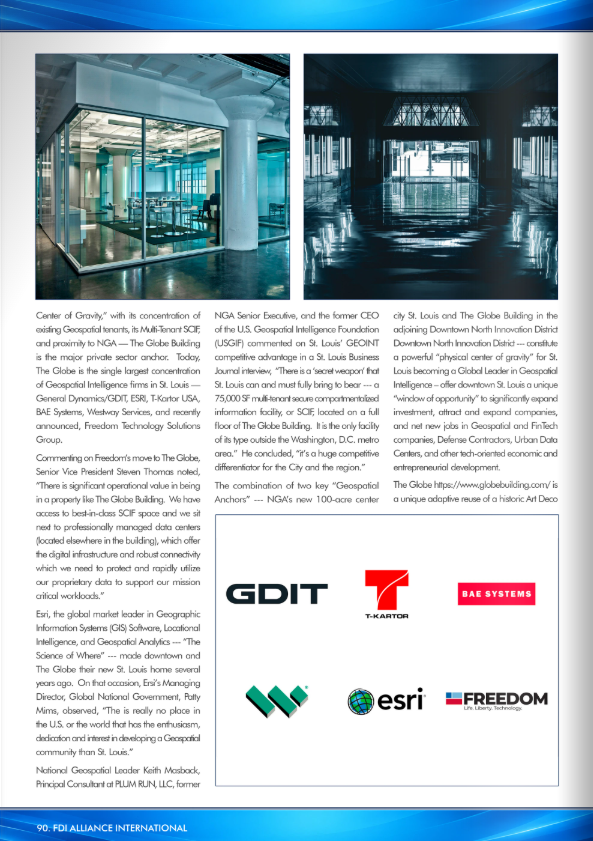
"Geospatial Center of Gravity": paralleling NGA as the public sector anchor of "St. Louis' Geospatial Center of Gravity," with its concentration of existing Geospatial tenants, its Multi-Tenant SCIF, and proximity to NGA — The Globe Building is the major private sector anchor. Today, The Globe is the single largest concentration of Geospatial Intelligence firms in St. Louis — General Dynamics/GDIT, ESRI, T-Kartor USA, BAE Systems, Westway Services, and recently announced, Freedom Technology Solutions Group.
Commenting on Freedom's move to The Globe, Senior Vice President Steven Thomas noted, "There is significant operational value in being in a property like The Globe Building. We have access to best-in-class SCIF space and we sit next to professionally managed data centers (located elsewhere in the building), which offer the digital infrastructure and robust connectivity which we need to protect and rapidly utilize our proprietary data to support our mission critical workloads."
Esri, the global market leader in Geographic Information Systems (GIS) Software, Locational Intelligence, and Geospatial Analytics --- "The Science of Where" --- made downtown and The Globe their new St. Louis home several years ago. On that occasion, Esri's Managing Director, Global National Government, Patty Mims, observed, "The is really no place in the U.S. or the world that has the enthusiasm, dedication and interest in developing a Geospatial community than St. Louis."
National Geospatial Leader Keith Masback, Principal Consultant at PLUM RUN, LLC, former NGA Senior Executive, and the former CEO of the U.S. Geospatial Intelligence Foundation (USGIF) commented on St. Louis' GEOINT competitive advantage in a St. Louis Business Journal interview, "There is a 'secret weapon' that St. Louis can and must fully bring to bear --- a 75,000 SF multi-tenant secure compartmentalized information facility, or SCIF, located on a full floor of The Globe Building. It is the only facility of its type outside the Washington, D.C. metro area." He concluded, "it's a huge competitive differentiator for the City and the region."
The combination of two key "Geospatial Anchors" --- NGA's new 100-acre center city St. Louis and The Globe Building in the adjoining Downtown North Innovation District --- constitute a powerful "physical center of gravity" for St. Louis becoming a Global Leader in Geospatial Intelligence – offer downtown St. Louis a unique "window of opportunity" to significantly expand investment, attract and expand companies, and net new jobs in Geospatial and FinTech companies, Defense Contractors, Urban Data Centers, and other tech-oriented economic and entrepreneurial development.

The Globe is a unique adaptive reuse of a historic Art Deco building into a high-tech mixed-use development, which bridges commercial innovation, academic research, advanced manufacturing, AI, and national security --- providing a number of unique attributes for St. Louis' GEOINT Ecosystem, such as:
Lowering Barriers to Entry for Small & Mid-Sized Tech Firms: Traditional SCIF infrastructure is prohibitively expensive for startups and mid-market defense companies to build and accredit independently. By offering a multi-tenant model, the building allows multiple private companies and subcontractors to lease accredited, secure space on a shared-cost basis. The SCIF at The Globe is the largest such entity outside of D.C./Northern Virginia metro;
Providing Unique Proximity to NGA Campus West: Situated just blocks from the new Geospatial-Intelligence Agency's multi-billion-dollar NGA West Campus, the facility provides secure workspace for defense contractors and intelligence partners needing physical proximity and secure connectivity to NGA personnel;
Fostering Classified & Unclassified Collaboration: The building houses both commercial tech labs and classified spaces, enabling firms to work on open-source spatial analytics, commercial earth observation data, and AI/ML processing before transitioning classified deliverables into secure environments; and,
Anchoring the Downtown Innovation District: Beyond security infrastructure, the building serves as a major node in the regional tech corridor alongside partners like T-REX, Taylor Geospatial Institute, and Saint Louis University's geospatial initiatives, helping attract talent and private investment to St. Louis.
The recently created Washington Avenue Community Improvement Corridor District (CID) surrounding downtown loft housing was created to serve as a formal structure in tandem with the collaboration in the Downtown North District.
In economic development, it doesn't get much better for a community than to have the development of a $1.75-billion, 100-acre, 1-million square foot new NGA campus adjacent to its downtown. This "Economic Development Game Changer" is precisely what has taken place in St. Louis' center city.